 Independent analysis of bamboo materials and the systems around them.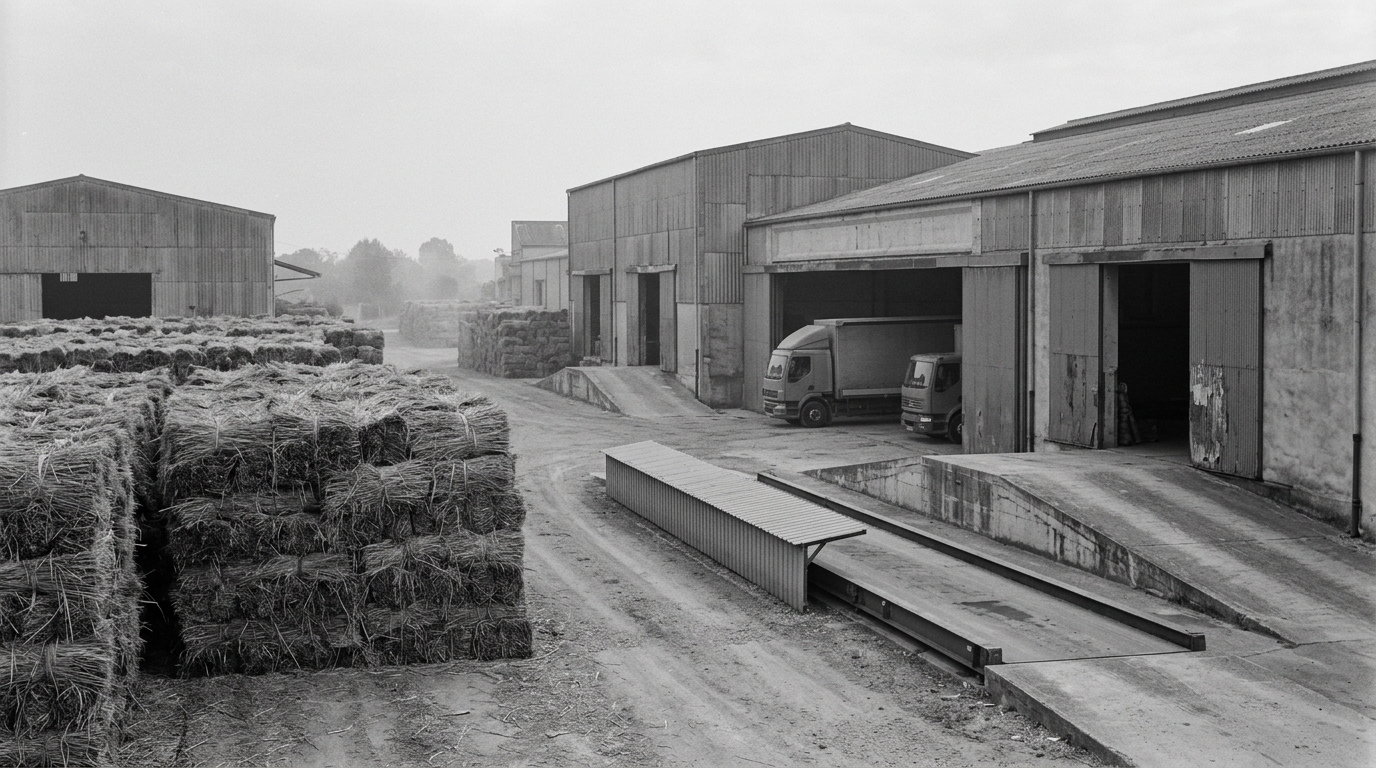
Quick takeaways
- 01
Growing area measures biological potential; it does not prove that feedstock can be delivered at the required time, quality, or cost.
- 02
Collection points, intake specifications, logistics, traceability, and purchasing rules must operate as one system rather than as separate initiatives.
- 03
A credible industrial supply chain is demonstrated through repeatable flows and auditable decisions, not by the size of a colored area on a map.
Growing area does not automatically become usable feedstock
A map can show where bamboo grows, how broad a potential sourcing zone may be, or where cultivation could be expanded. It cannot show how much material is available at a given moment, what condition it is in, or whether suppliers can deliver it to a factory under a common specification. Biological potential is therefore the beginning of a supply question, not the answer.
Industrial production needs a continuous flow with defined variation. Harvesting cycles, species, culm age, moisture, contamination, distance, road access, and seasonal weather can all change what arrives at the gate. Even where bamboo is abundant, the usable share can be much smaller once timing, quality, and logistics are considered.
The useful unit of analysis is not simply hectares. It is the amount of conforming material that can be identified, collected, transported, received, and recorded without breaking the economics or the quality system. That requires a network capable of turning many local decisions into one controlled industrial flow.
Collection and logistics determine the real flow
Collection points are not merely parking areas between farms and factories. They can serve as places for identification, basic sorting, moisture checks, bundling, weighing, and documentation. Their role depends on the supply model, but the principle is consistent: problems are cheaper to identify before transport than after material enters a factory queue.
Location matters because biomass is bulky and variable. A supply network must understand where transport cost rises sharply, where seasonal access becomes unreliable, and where waiting time creates congestion. The objective is not to minimize distance in isolation. It is to design a flow that remains predictable when volume, weather, or local availability changes.
Routing, vehicle scheduling, and receiving windows also affect factory stability. A production line cannot compensate indefinitely for irregular arrivals. Too little material causes stoppages; too much material creates storage pressure, moisture change, and handling risk. The logistics system therefore needs to be connected to production planning rather than managed as a separate transport function.
Intake standards create a common language
A supply chain becomes controllable when buyers, collectors, transporters, and suppliers understand the same acceptance rules. Those rules may cover species, dimensions, age range, moisture, foreign material, damage, bundling, documentation, and sampling. The exact list depends on the intended process and must be validated for that process.
The main purpose of an intake specification is not to reject suppliers. It is to make quality visible before disputes occur. A supplier needs to know what will be measured, how it will be measured, and what happens when material falls outside the agreed range. A buyer needs records that connect the received load to later production outcomes.
Sampling deserves particular care. Testing every culm may be impossible, while weak sampling can hide variation. A workable method must state where samples are taken, which device or procedure is used, and how results affect acceptance, reclassification, or price. Without that discipline, the same load can be judged differently by different people.
Traceability and purchasing discipline create control
Traceability should answer practical questions: where did the load come from, who supplied it, when was it harvested or collected, what checks were performed, which lot received it, and how was any deviation handled? The goal is not to create paperwork for its own sake. It is to preserve the link between feedstock decisions and product outcomes.
Purchasing discipline is equally important. If pricing rules, deductions, payment timing, or quality classifications change informally, suppliers adapt by withholding information or optimizing for the latest negotiation. A stable mechanism makes expectations visible and allows both sides to plan.
Traceability also improves learning. When a production deviation appears, the factory can compare it with feedstock origin, moisture, storage duration, and intake results. Over time, this creates a stronger basis for supplier development and specification adjustment. The supply system becomes capable of correcting itself instead of relying on memory.
The market needs to see a network, not a map
A credible feedstock narrative describes how potential is converted into controlled flow. It shows collection logic, quality rules, data ownership, exception handling, and the relationship between logistics and production planning. It also states what remains uncertain.
This distinction protects both technical judgment and public communication. A large growing area may be important, but it should not be presented as material already contracted, available, or suitable. Those are separate claims that require separate evidence.
The central question is therefore not “How much bamboo exists?” It is “How much conforming bamboo can the system identify, move, receive, and learn from under repeatable conditions?” That is the threshold between a resource story and an industrial supply capability.